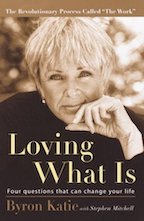
The Unexpected Awakening of Byron Katie
Byron Kathleen Reid, known to the world as Byron Katie, was born in Breckenridge, Texas in 1942. Her journey to becoming a spiritual teacher and self-help author is as unconventional as her methods. For over a decade, Katie suffered from severe depression, agoraphobia, and addiction. Her transformation came suddenly and unexpectedly in 1986, while she was in a halfway house for women with eating disorders.
The Cockroach Epiphany
One morning, lying on the floor, Katie experienced a life-changing realization. As she describes it, she woke up without any concept of self. In that moment, seeing a cockroach crawl over her foot, she realized that all her suffering came from her thoughts about reality, not reality itself. This profound insight became the foundation of her work.
“Loving What Is”: An Introduction
Published in 2002, “Loving What Is: Four Questions That Can Change Your Life” introduces Katie’s method of self-inquiry known as “The Work.” The book presents a radical approach to dealing with suffering, suggesting that our problems stem not from the world around us, but from our thoughts about the world.
The Book’s Structure
“Loving What Is” is divided into several chapters, each exploring different aspects of Katie’s philosophy and method. The book includes transcripts of Katie facilitating The Work with individuals, allowing readers to see the process in action. This practical approach makes the concepts more accessible and demonstrates their application in real-life situations.
The Four Questions of The Work
At the heart of Katie’s method are four questions designed to investigate stressful thoughts. These questions, along with what Katie calls “turnarounds,” form the core of The Work.
Question 1: Is it true?
The first question invites us to consider the absolute truth of our thought. Katie emphasizes the importance of answering with a simple yes or no, avoiding justifications or explanations.
Question 2: Can you absolutely know that it’s true?
This question delves deeper, asking us to consider whether we can be absolutely certain about the truth of our thought. It often reveals the limitations of our knowledge and perspective.
Question 3: How do you react when you believe that thought?
This question explores the impact of believing the thought. It encourages us to notice the emotions, physical sensations, and behaviors that arise when we believe the stressful thought.
Question 4: Who would you be without the thought?
The final question invites us to imagine how we would experience the same situation without believing the stressful thought. This often reveals new possibilities and perspectives.
The Turnaround: A Key to Freedom
After answering the four questions, Katie introduces the concept of the “turnaround.” This involves considering opposite statements to the original thought and finding genuine examples of how these could be as true or truer than the original belief.
Types of Turnarounds
Katie identifies several types of turnarounds: to the self, to the other, to the opposite, and to “the thinking.” Each type offers a different perspective on the original thought, often leading to profound insights and shifts in understanding.
Key Concepts in “Loving What Is”
Beyond The Work itself, “Loving What Is” introduces several key concepts that form the foundation of Katie’s philosophy.
The Three Kinds of Business
Katie identifies three types of “business”: my business, your business, and God’s business (or reality’s business). She suggests that much of our stress comes from mentally living in someone else’s business, rather than staying in our own.
Loving What Is
The titular concept of the book, “loving what is,” refers to the practice of accepting reality as it is, rather than arguing with it. Katie suggests that all suffering comes from arguing with reality, and that peace is the result of aligning our thoughts with what is.
Practical Applications of The Work
“Loving What Is” is not just a theoretical text; it provides practical tools for applying The Work in everyday life. Katie encourages readers to write down their stressful thoughts and systematically question them using the four questions and turnarounds.
The Judge-Your-Neighbor Worksheet
One of the key tools introduced in the book is the Judge-Your-Neighbor Worksheet. This structured format helps readers identify and investigate their stressful thoughts about others, providing a concrete starting point for self-inquiry.
Criticisms and Controversies
While many have found Katie’s work transformative, it has not been without its critics. Some argue that The Work could lead to a form of spiritual bypassing, where difficult emotions or situations are prematurely dismissed rather than fully processed.
The Question of Responsibility
Others have raised concerns about the implications of Katie’s philosophy for issues of social justice and systemic oppression. Critics argue that the emphasis on changing one’s thoughts rather than external circumstances could be seen as absolving perpetrators of responsibility.
The Impact of “Loving What Is”
Despite these criticisms, “Loving What Is” has had a significant impact since its publication. The book has been translated into over 30 languages and has sold millions of copies worldwide. Katie’s work has been embraced by individuals seeking personal growth and has also found applications in therapy, coaching, and even corporate settings.
Celebrity Endorsements
Like many influential self-help books, “Loving What Is” has benefited from celebrity endorsements. Notable figures such as Eckhart Tolle, Tony Robbins, and Oprah Winfrey have praised Katie’s work, helping to expand its reach and influence.
Beyond “Loving What Is”
While “Loving What Is” remains Katie’s most well-known work, she has authored several other books that expand on her philosophy. These include “I Need Your Love – Is That True?” which applies The Work to relationships, and “A Thousand Names for Joy,” which explores living in harmony with the way things are.
Katie’s Ongoing Work
Today, Byron Katie continues to teach The Work through workshops, retreats, and online programs. She has adapted her teachings to various formats, including a mobile app that guides users through the process of self-inquiry.
Integrating The Work into Daily Life
For many readers, the challenge lies in consistently applying The Work to their daily lives. Katie encourages people to start with small, everyday stressful thoughts and to approach the process with an attitude of playful curiosity rather than grim determination.
The Work as a Meditation
Katie often describes The Work as a form of meditation. By consistently questioning our stressful thoughts, we can develop a more peaceful and accepting relationship with reality, leading to what Katie calls “a mind at home with itself.”
Conclusion: The Lasting Impact of “Loving What Is”
Nearly two decades after its publication, “Loving What Is” continues to offer a powerful approach to dealing with stress and suffering. Its simple yet profound method of self-inquiry has provided many with a tool for finding peace and clarity in the face of life’s challenges.
A New Paradigm of Self-Help
Byron Katie’s work represents a significant shift in the self-help landscape. Rather than offering strategies for changing our circumstances or achieving specific goals, The Work invites us to change our relationship with our thoughts and, by extension, with reality itself. In a world that often seems chaotic and stressful, Katie’s message—that peace is available to anyone willing to question their thoughts—continues to resonate with seekers around the globe.